
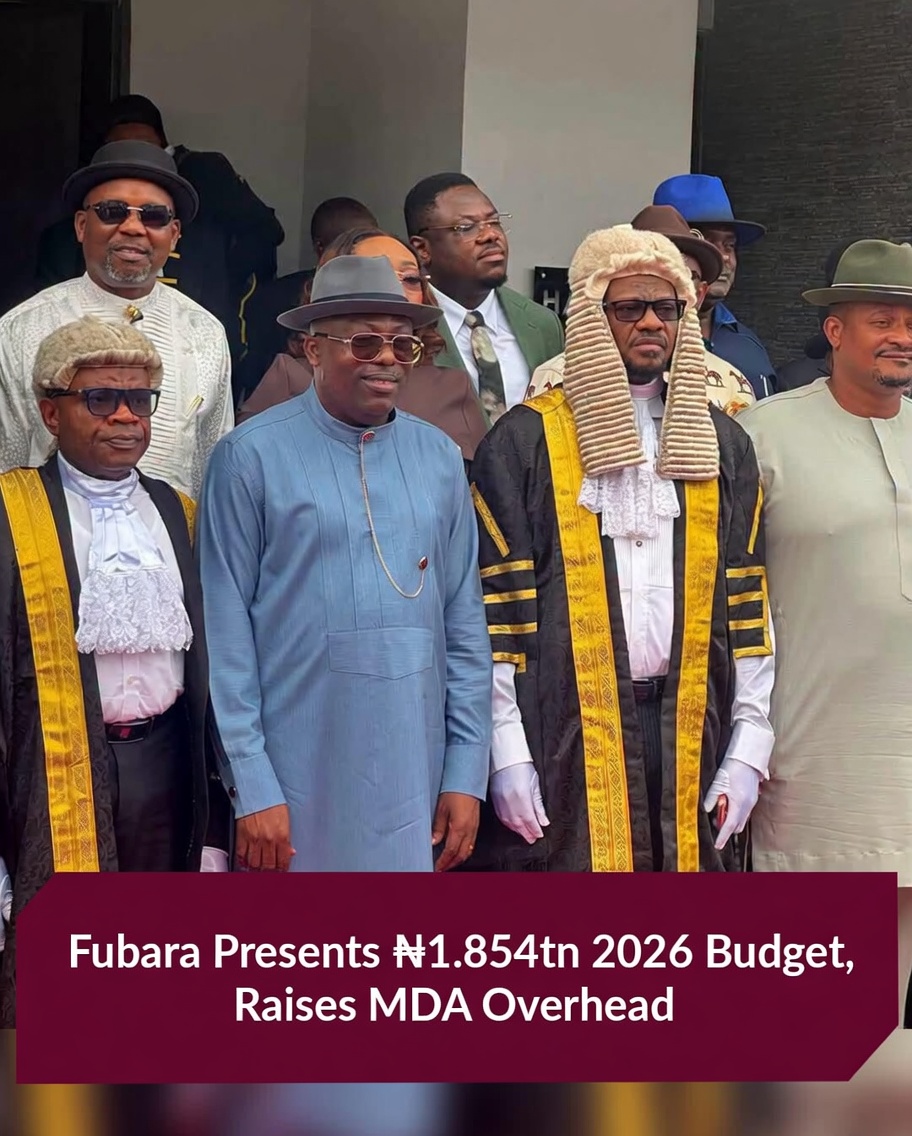
Fubara Presents ₦1.854 Trillion 2026 Budget to Rivers Assembly, Signals End to Political Rift
E-ISSN: 2354-4481
By Augustine Favour Nkechinyere
PORT HARCOURT — Rivers State Governor, Sir Siminalayi Fubara, on Friday presented the state's 2026 Appropriation Bill of ₦1.854 trillion to the Rivers State House of Assembly for consideration and approval, in what has been widely interpreted as a major indication that the prolonged political crisis between the executive and the legislature has finally eased.
The proposed budget, christened "Budget of Resilience for Growth and Development," represents a 24.49 per cent increase over the 2025 appropriation and is designed to consolidate economic growth, improve public service delivery, strengthen infrastructure, and enhance the welfare of workers and retirees across the state.
Presenting the estimates before lawmakers, Governor Fubara explained that the increase in the budget size was driven by improved revenue projections, particularly higher allocations from the Federation Account Allocation Committee (FAAC), sustained growth in internally generated revenue, and increased capital receipts.
According to the governor, the budget projects ₦487.6 billion as internally generated revenue, approximately ₦936 billion from FAAC allocations, and about ₦382.4 billion in capital receipts to finance the state's development programmes.
On the expenditure side, Governor Fubara proposed ₦413.1 billion for recurrent expenditure, with ₦154.7 billion earmarked for salaries of public servants and ₦15.2 billion allocated for the recruitment of additional personnel into the state workforce.
The budget also provides ₦36.7 billion for overhead costs of ministries, departments and agencies (MDAs), ₦20 billion each for gratuities and monthly pensions, as well as ₦5 billion for insurance obligations.
In a move expected to improve the efficiency of government institutions, the governor announced a 50 per cent increase in overhead allocations to MDAs, saying the decision would help address rising operational costs while enabling agencies to discharge their responsibilities more effectively.
He also disclosed that part of the increased allocation would facilitate the settlement of outstanding salary arrears owed to civil servants, reaffirming his administration's commitment to workers' welfare and improved public service.
Governor Fubara called on members of the House of Assembly to give the budget speedy consideration and approval, stressing that its implementation would accelerate infrastructure development, stimulate economic activities, create employment opportunities, and improve the living standards of Rivers people.
The budget presentation carries significant political symbolism, coming after nearly three years of intense political disagreements that strained relations between the executive arm and the Rivers State House of Assembly.
The crisis, which began in late 2023 following a leadership dispute within the Assembly, resulted in prolonged institutional tensions, legal battles, parallel legislative activities, and disagreements over governance. The conflict also drew national attention and prompted interventions by political stakeholders and the Presidency.
For months, governance in the oil-rich state was overshadowed by uncertainty as both arms of government remained at loggerheads over constitutional and political issues.
However, recent reconciliation efforts and renewed engagement between Governor Fubara and members of the Assembly have gradually restored cooperation between the two institutions.
Friday's presentation of the 2026 Appropriation Bill before the House has therefore been viewed by many political observers as one of the clearest indications that normal legislative-executive relations have returned, allowing both arms of government to focus on governance and development rather than political disputes.
Several stakeholders have welcomed the development, describing the budget presentation as a positive signal for political stability and economic progress in Rivers State.
Political analysts noted that the restoration of cooperation between the executive and legislature is expected to improve policy implementation, facilitate timely passage of government programmes, and strengthen investors' confidence in the state.
Labour leaders and public sector workers also expressed optimism over the governor's commitment to workers' welfare, particularly the proposed recruitment of new employees, increased operational funding for government agencies, and plans to clear outstanding salary obligations.
Economic observers equally commended the administration's emphasis on balancing recurrent expenditure with development spending, noting that improved revenue performance could enhance the state's capacity to deliver critical infrastructure and social services if efficiently managed.
With the presentation of the 2026 budget now before the Rivers State House of Assembly, attention will shift to legislative scrutiny and eventual passage of the appropriation bill, which will determine the financial framework for the state's programmes and projects in the coming fiscal year.
For many residents, however, the most significant outcome of the day's proceedings extends beyond the budget figures. The sight of the governor presenting the state's fiscal plan before a cooperative House of Assembly has reinforced growing confidence that Rivers State may finally be turning the page on one of the most turbulent political chapters in its recent history and returning its focus to governance, development, and service delivery.