
Imo High Court Nullifies CTC of Judgment Over Alteration of Court Record
ISSN: 2354-4481
By Mordi Azubuike Faustino
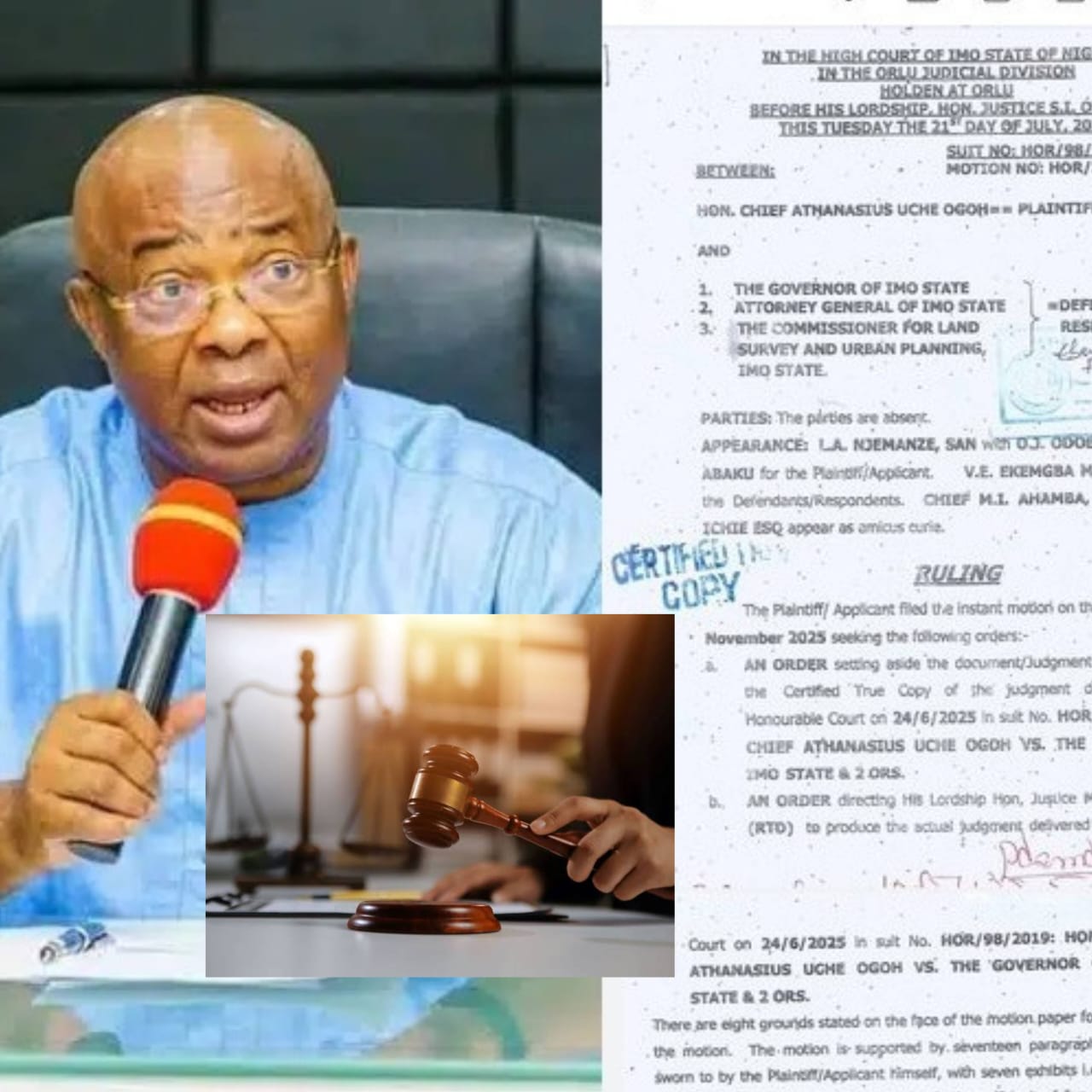
OWERRI, Imo State — The Imo State High Court has nullified a Certified True Copy (CTC) of a judgment after finding that the document did not reflect the decision delivered by the court in open proceedings.
The ruling, delivered by Justice S.I. Okpara on July 21, 2026, has raised fresh concerns over the integrity and management of judicial records in the state.
The case arose from a land-related suit in which Justice M.E. Nwagboso, on June 24, 2025, delivered judgment against the Governor of Imo State.
However, a Certified True Copy subsequently issued by the court reportedly contained a decision that reversed the outcome of the judgment delivered in open court and instead favoured the governor.
The party who had succeeded in the original judgment challenged the CTC and asked the court to set it aside on the grounds that it did not represent the decision actually pronounced by Justice Nwagboso.
In determining the application, Justice Okpara examined the relevant court records and found discrepancies between the judgment delivered in open court and the CTC subsequently issued.
The court further discovered that the official record book had been altered, while the original judgment notes were concealed.
Justice Okpara consequently held that the CTC issued on July 23, 2025, did not constitute the judgment that was delivered and read in open court.
The judge declared the disputed CTC a nullity, effectively removing its legal effect.
The decision was based on the principle that a court has inherent jurisdiction to set aside an order or judicial document that is shown to be a nullity.
The ruling underscores the importance of accuracy and transparency in the preparation, preservation and certification of judicial records, particularly because certified court documents are relied upon by litigants, lawyers, appellate courts and other institutions in determining legal rights and obligations.
The circumstances surrounding the disputed CTC have also attracted attention because of the judicial history of Justice Nwagboso, who had previously been retired by the National Judicial Council.
The latest ruling does not merely concern the validity of a particular certified document but also raises broader questions about the procedures used in recording and certifying judgments after they have been delivered.
A judgment pronounced in open court is expected to remain the authoritative expression of the court's decision, while any subsequent certified copy should accurately reproduce that decision.
The finding that the court's record book was altered and the original judgment notes concealed therefore adds a significant dimension to the matter.
The case is likely to generate further discussion among legal practitioners and stakeholders over judicial accountability, the preservation of court records and safeguards against alterations to judgments after delivery.
Justice Okpara's ruling ultimately reaffirmed that the integrity of judicial proceedings depends not only on the decisions delivered by judges but also on the accuracy and reliability of the records through which those decisions are preserved and enforced.