
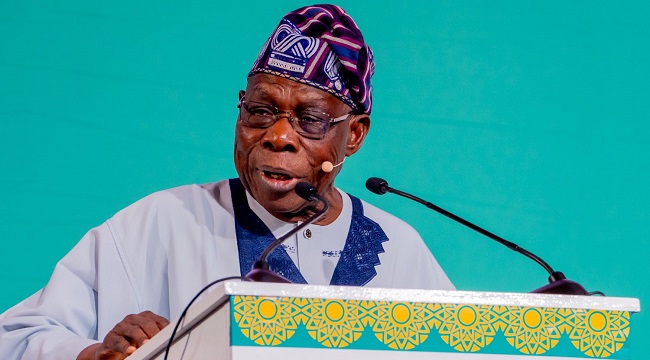
Obasanjo Recounts How EFCC Probe Led to Ibori’s London Conviction
E-ISSN: 2354-4481
By Desmond Chimezie Abiaziem
Former President Olusegun Obasanjo has recounted the circumstances surrounding the Economic and Financial Crimes Commission’s (EFCC) investigation of former Delta State Governor, Chief James Ibori, while responding to allegations that he was vindictive towards the former governor.
Obasanjo said the EFCC investigation established that Ibori had misappropriated about $200 million during his tenure as governor, prompting him to personally confront the former governor and demand the recovery of a substantial portion of the funds.
The former president made the disclosure while responding to allegations previously made by Ibori and the late former Bayelsa State Governor, Chief Diepreye Alamieyeseigha, who had accused him of using state institutions to settle political scores.
According to Obasanjo, the EFCC submitted its findings on Ibori to him after investigating the former governor’s financial activities.
He said he subsequently summoned Ibori, showed him the report and directed him to return $150 million to the EFCC, assuming that about $50 million had already been spent.
“EFCC investigated Ibori, and they found Ibori had misappropriated about $200m. And they brought the report to me,” Obasanjo said in recounting the episode.
Obasanjo said Ibori subsequently asked where the money should be paid. He told him that the money belonged to Delta State and should therefore be returned to the state.
According to him, arrangements were subsequently made for a Central Bank of Nigeria (CBN) account through which the funds could be deposited for the state.
Obasanjo further recalled that Ibori questioned why such an account should be created for Delta State alone, arguing that similar accounts should be opened for other states if the arrangement was legitimate.
The former president said he accepted the proposal and directed that accounts be created for the states.
The account of the episode later shifted to an alleged $15 million cash payment involving Ibori and then EFCC Chairman, Nuhu Ribadu.
Obasanjo said Ibori attempted to be “clever” by taking $15 million in cash to Ribadu. He said Ribadu reported the development and the money was subsequently deposited with the CBN.
Historical accounts confirm that $15 million in cash was taken into EFCC custody and deposited with the CBN. Ribadu later testified that the money had been offered by Ibori in connection with the investigation.
The circumstances surrounding the $15 million payment have, however, been disputed over the years, with different accounts concerning whether it constituted a bribe or a payment intended as restitution, as well as differences in testimony concerning the circumstances surrounding its collection and deposit.
Obasanjo said the authorities continued pursuing the wider case against Ibori after the payment, eventually leading to his departure from Nigeria and subsequent legal proceedings in the United Kingdom.
Ibori left Nigeria for Dubai in 2010 after facing renewed corruption allegations. He was arrested in Dubai and later extradited to the United Kingdom in 2011. In 2012, he pleaded guilty at Southwark Crown Court in London to 10 counts involving fraud and money laundering and was sentenced to 13 years in prison.
Obasanjo’s latest account was therefore presented in the context of his response to claims that the investigation and subsequent prosecution of Ibori were motivated by personal or political vindictiveness.
The former president maintained that his actions were driven by the need to recover public funds and pursue allegations arising from the EFCC investigation.
His account has nevertheless remained part of a long-running debate over the handling of the Ibori case, particularly the circumstances surrounding the $15 million payment and the relationship between the former president, the EFCC and the former Delta governor.