
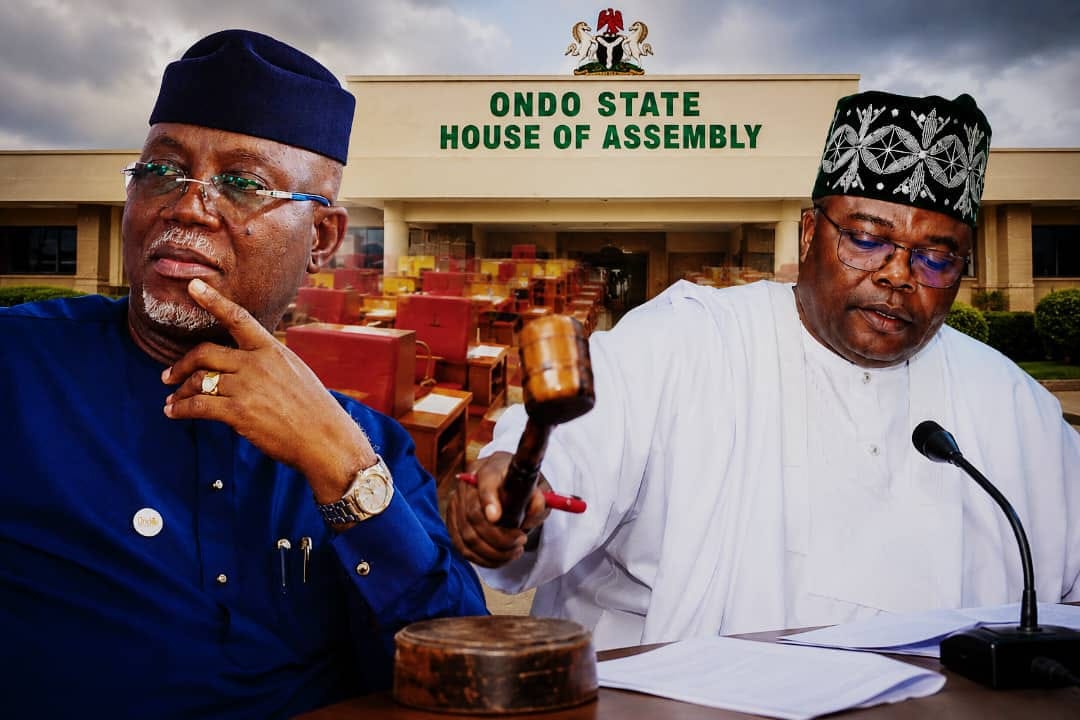
Ondo Assembly Crisis Deepens as 21 Lawmakers Reject Governor's Plea, Push for Speaker's Removal Over Alleged N44m Mismanagement
E-ISSN: 2354-4481
By Okpai Ayade Sunday
The political crisis rocking the Ondo State House of Assembly has deepened as 21 of the 26 lawmakers have reportedly resolved to proceed with plans to remove the Speaker, Rt. Hon. Olamide Oladiji, despite intervention by Governor Lucky Aiyedatiwa aimed at resolving the impasse.
The lawmakers are insisting that the Speaker must vacate office over allegations of financial misconduct and abuse of legislative procedures, setting the stage for one of the most significant political confrontations in the state's recent history.
According to sources within the Assembly, the rebellion was triggered by claims that the Speaker allegedly mismanaged N44 million belonging to the legislature and unilaterally altered the N9.2 billion budget of the Ondo State Oil Producing Areas Development Commission (OSOPADEC) without the approval of the House.
The aggrieved lawmakers contend that the alleged actions violated established legislative procedures and internal protocols. They further claimed that the unauthorized alterations amounted to forgery and undermined the integrity of the Assembly's legislative process.
Efforts by Governor Lucky Aiyedatiwa to calm tensions and encourage dialogue reportedly failed after the majority of lawmakers rejected calls for compromise. The legislators maintained that the executive arm should not interfere in the internal affairs of the legislature, insisting that their decision to remove the Speaker was final.
Sources familiar with the development disclosed that although the governor sought a negotiation window to allow reconciliation among the lawmakers, the move was met with stiff resistance. The lawmakers reportedly declared that no political pressure or executive intervention would alter their resolve.
The development has heightened political tension within the state as stakeholders closely monitor events that could reshape the leadership of the House of Assembly.
The Ondo State House of Assembly comprises 26 members, meaning the support of 21 lawmakers represents an overwhelming majority capable of determining the fate of the Speaker if constitutional and legislative procedures are duly followed.
The latest crisis comes amid increasing public scrutiny over the management of public resources and the implementation of development projects across Ondo State.
OSOPADEC, one of the state's most strategic intervention agencies, was established to utilize funds accruing from the 13 percent oil derivation allocation to improve the welfare and infrastructure of oil-producing communities. The commission is expected to channel resources into the construction of roads, schools, healthcare facilities, water projects, rural electrification, environmental remediation, youth empowerment, and other critical development initiatives.
Given the enormous expectations placed on the commission, any allegation involving its budget naturally attracts widespread public attention and demands for transparency.
Observers note that disputes over the management and appropriation of public funds have, over the years, remained a recurring source of political disagreements in several state legislatures across Nigeria.
The unfolding crisis has generated mixed reactions from political observers, civil society organizations, and public affairs analysts.
Many analysts argue that regardless of the political dimensions of the controversy, the allegations underscore the urgent need for greater accountability, transparency, and prudence in the management of public funds.
According to public affairs analysts, institutions entrusted with public resources must operate in accordance with due process while ensuring that every expenditure is subjected to legislative scrutiny and public accountability.
They further maintained that the allegations surrounding the OSOPADEC budget should be independently investigated to protect public confidence in government institutions and strengthen democratic governance.
The analysts also stressed that OSOPADEC, which receives substantial funding from the 13 percent derivation allocation, must remain focused on its core mandate of transforming the living conditions of residents in Ondo State's oil-producing communities.
They noted that the commission was created primarily to address decades of infrastructural deficits, environmental degradation, unemployment, and underdevelopment affecting the riverine and rural communities that contribute significantly to Nigeria's oil wealth.
According to them, every allocation to the commission should translate into visible projects that improve roads, schools, healthcare services, potable water supply, rural electrification, skills acquisition, and economic opportunities for local residents.
They argued that transparent management of the commission's resources would not only accelerate rural development but also strengthen public trust in government institutions and ensure that the benefits of the derivation fund reach the communities for which they were intended.
As political consultations continue behind closed doors, attention now shifts to the Ondo State House of Assembly, where the coming days are expected to determine whether the Speaker can survive the mounting pressure from the overwhelming majority of lawmakers.
For many observers, the outcome of the crisis will serve as an important test of legislative independence, constitutional governance, and accountability in the management of public resources in Ondo State.