
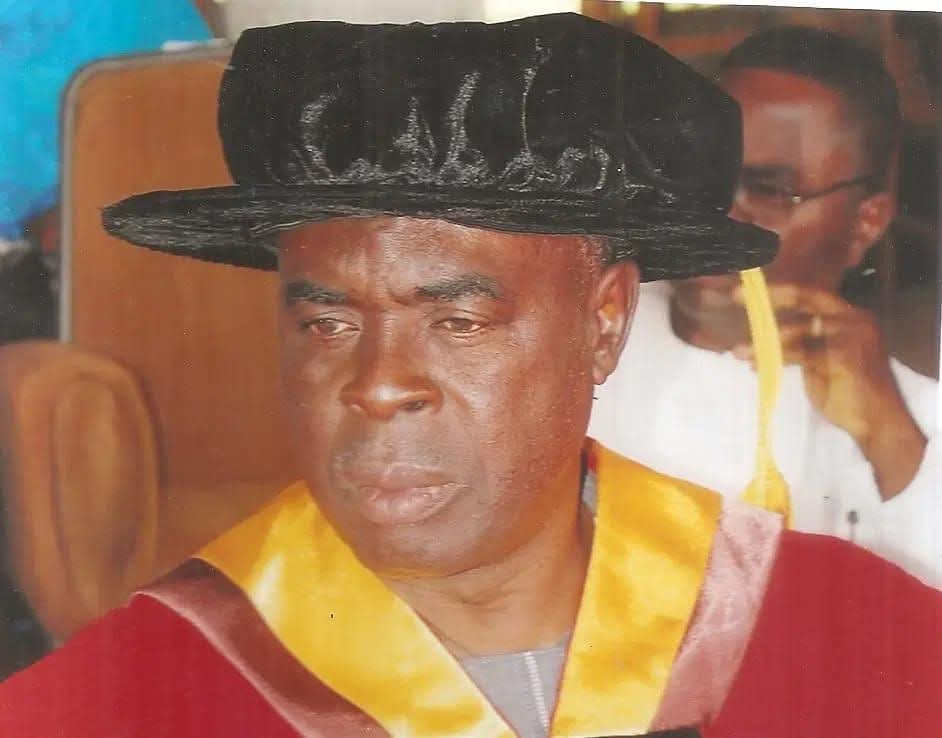
TRIBUTE TO PROFESSOR DAMIAN UGWUTIKIRI OPATA: A DISTINGUISHED SCHOLAR, A TEACHER OF HISTORY AND HUMANITY, AND A TREASURE LOST
E-ISSN: 2354-4481
By Hon. John Mbonu Uchenwoke-Ekperechi
Publisher and Editor-in-Chief, Inside Agwa News
The news of the death and burial of Professor Damian Ugwutikiri Opata, a distinguished scholar of the Department of English and Literary Studies, University of Nigeria, Nsukka (UNN), has brought deep sadness to me personally and to the wider academic community.
Professor Opata was not merely a renowned academic whose name appeared in scholarly publications and university records. He was also one of the lecturers whose intellectual contributions formed part of my academic journey at the University of Nigeria, Nsukka, where I studied History, English and Literary Studies (History/English with History as my base department).
As his former student, I receive his passing with a profound sense of personal loss. The death of a teacher is a reminder that, while academic institutions may continue to function and generations of students may come and go, the individuals who shape our intellectual development leave imprints that cannot easily be erased.
Professor Opata's passing on 16 October 2026 and burial on 17 October 2026, in his country home, Lejja, mark the end of a remarkable chapter in the life of a scholar whose work engaged African literature, Igbo philosophy, cultural identity, language, traditional values and the wider questions of human existence.
A LIFE DEVOTED TO SCHOLARSHIP AND LEARNING
Born on 3 July 1951, Professor Damian Ugwutikiri Opata hailed from Lejja in Nsukka Local Government Area of Enugu State. His academic journey began at the University of Nigeria, Nsukka, where he studied, taught, conducted research and served in several administrative capacities.
Late Prof. Damian Opata, obtained a Bachelor of Arts degree with honours in English in 1975, a Master of Arts degree in English in 1979, and a Master of Arts degree in Philosophy in 1999. These qualifications reflected an intellectual interest that extended beyond literature into philosophy, culture and the foundations of human thought.
His professional career at UNN began as a Junior Fellow in the Department of English from 1976 to 1979. He subsequently served as Lecturer II from 1980 to 1984, Lecturer I from 1984 to 1987, and Senior Lecturer from 1987 to 1996. He attained the rank of Professor in 1996, according to his published academic record.
His career was characterised not only by teaching and research but also by university leadership and service. He served as Associate Dean of the Faculty of Arts from 1999 to 2002, represented the Faculty of Arts on the University Senate during the same period, and served as Acting Head and subsequently Head of the Department of English and Literary Studies. He also served as Dean of the Faculty of Arts from 2008 to 2010.
These responsibilities demonstrated the breadth of his contribution to the administration and intellectual life of the university.
AN INTELLECTUAL BRIDGE BETWEEN AFRICAN LITERATURE AND IGBO WORLDVIEW
Professor Opata's scholarship was particularly significant because it explored the relationship between literature, culture, philosophy, religion and society.
His work examined how African societies interpret the world through proverbs, folklore, customary beliefs, moral values and literary expression. In doing so, he contributed to scholarly conversations about the intellectual traditions of African peoples and the importance of understanding indigenous knowledge on its own terms.
Among his notable books are Essays on Igbo World View (1998), Major Themes in African Literature (2000), which he co-edited with A. U. Ohaegbu, and Ekwensu in the Igbo Imagination: A Christian Devil or an Igbo Heroic Deity? (2005).
His other important works include Towards a Genealogy of African Time (2002), Ajija: An Igbo Agent of Death and Destruction (2009), and Faith, Culture and Individual Freedom: Notes and Extrapolations from Lejja Catholic Parish, Nsukka Diocese (2011).
His 2008 inaugural lecture, Delay and Justice in the Lore and Literature of Igbo Extraction, explored questions of justice through the cultural traditions and literary expressions of Igbo society.
These titles reflect a scholar who was deeply interested in the ideas, values and worldviews through which people understand their communities and their place in the world.
A SCHOLAR WHO ENGAGED THE WORK OF CHINUA ACHEBE
Professor Opata also made notable contributions to the critical study of African literature, including the works of Chinua Achebe.
His published articles include “Eternal Sacred Order Versus Conventional Wisdom: A Consideration of Moral Culpability in the Killing of Ikemefuna in Things Fall Apart,” published in Research in African Literatures in 1987.
He also wrote “The Sudden End of Alienation: A Reconsideration of Okonkwo's Suicide in Things Fall Apart,” published in Africana Marburgensia in 1989, and “The Structure of Order and Disorder in Chinua Achebe's Things Fall Apart,” published in Neohelicon.
These works illustrate his engagement with the moral, cultural and philosophical dimensions of African literary classics.
His contribution was not limited to analysing literary texts. He also investigated the place of proverbs in Igbo communication, the relationship between language and citizenship, the teaching of literature in African universities, and the philosophical foundations of African humanities.
Among his other published articles were “Adynaton Symbols in Igbo Proverbial Usage,” “The Nature of Speech in Igbo Proverbs,” and “Proverbs and Inter-Group Relations.”
Through these scholarly contributions, Professor Opata helped to document and interpret cultural knowledge that remains important to discussions of African identity, intellectual history and cultural continuity.
INTERNATIONAL SCHOLARSHIP AND ACADEMIC RECOGNITION
His academic engagements extended beyond the University of Nigeria, Nsukka.
The late Emeritus Prof. was a visiting fellowship at the University of Joensuu in Finland in 1992, a fellowship at the Institute of Advanced Humanities at the University of California, Santa Barbara, in 1996, and a fellowship at the Institute of Advanced Humanities, University of Ghana, Legon, in 1999.
He was also a laureate of the Council for the Development of Social Science Research in Africa (CODESRIA) in 2000 and served as a resource person at its Gender Institute in 2003.
He served as an external examiner for several Nigerian universities and higher institutions, contributing to academic assessment and the development of scholarship beyond his home institution.
Such engagements reflected the reach of his intellectual work and his participation in broader conversations about African literature, culture, philosophy and society.
BEYOND THE LECTURE ROOM: THE LEGACY OF A TEACHER
For students, a lecturer's influence is not measured exclusively by the number of books published, articles cited or administrative offices occupied. It is also measured by the intellectual curiosity a teacher inspires, the questions a student learns to ask, and the foundations laid for further learning.
As someone who studied History, English and Literary Studies at the University of Nigeria, Nsukka, I recognise the importance of the academics whose teaching forms part of a student's intellectual development.
Professor Opata belonged to that community of scholars whose work connected literary studies with history, philosophy, culture and the wider human experience.
His scholarship provides a valuable resource for students, researchers and future generations interested in African literature and Igbo cultural thought. His publications remain part of the documentary record of his intellectual life and can continue to inform research long after his passing.
For me, therefore, this is more than the passing of a professor whose achievements deserve public recognition. It is also the loss of a former lecturer whose place in my educational journey I will continue to acknowledge with gratitude.
A FAMILY AND UNIVERSITY COMMUNITY IN MOURNING
The loss is also deeply felt by his family, colleagues, friends, former students and the university community.
I extend my heartfelt condolences to his younger brother, Professor Chukwuma Christian Opata, of the Department of History and International Studies, University of Nigeria, Nsukka, as well as to the entire Opata family. Prof. C. C. Opata had more teaching times with me as my based department lecturer.
To Professor Chukwuma Christian Opata, the wider family, the Department of English and Literary Studies, the Faculty of Arts, the University of Nigeria, Nsukka, and all who mourn this distinguished scholar, I offer my sincere sympathy.
The loss of a family member is deeply personal, and the loss of a scholar whose life was devoted to education also touches the many people whose lives intersected with his work.
May the family find strength in the memories of his life, comfort in the support of friends and colleagues, and encouragement in the enduring value of his scholarly contributions.
HIS WORK WILL CONTINUE TO SPEAK
Professor Damian Ugwutikiri Opata has completed his earthly journey, but the books, articles, ideas and scholarly questions he leaves behind remain available to those willing to read, examine, challenge and build upon them.
His life reminds us of the enduring importance of scholarship that takes African intellectual traditions seriously and seeks to understand the relationship between literature, culture, philosophy and society.
As a former student of the University of Nigeria, Nsukka, I join his family, colleagues, former students and the wider academic community in mourning his passing. Late Prof. Damian Opata, was a knowledge giver in lucid manners and a leader!
May his scholarly legacy continue to inspire researchers and students. May his family be comforted, and may his soul rest in perfect peace.
Adieu, Professor Damian Ugwutikiri Opata.
Rest in peace, my former lecturer.
Your earthly journey has ended, but your intellectual footprints remain.
Signed:
Hon. John Mbonu Uchenwoke-Ekperechi
Publisher and Editor-in-Chief
Inside Agwa News (IAN)
History and International Studies
University of Nigeria, Nsukka (Former Student)