
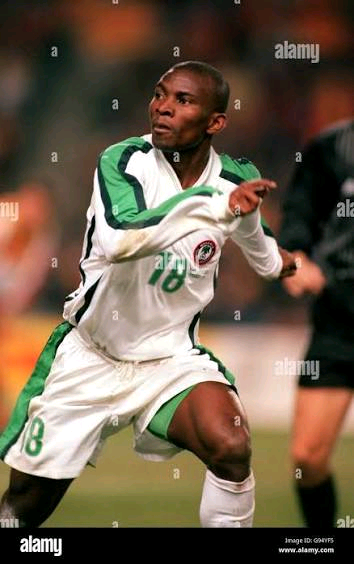
FOOTBALL FLASHBACKS: PASCAL OJIGWE — THE PICK OF THE WEEK
ISSN: 2354-4481
By Jeff Onuegbu
In Nigerian football history, some names dominate headlines while others remain quietly etched in the story of the game. Pascal Karibe Ojigwe belongs to the latter category — a disciplined midfielder-turned-defender whose career took him from the football grounds of Aba to the Bundesliga and the summit of European club football.
Born on 11 December 1976 in Aba, Abia State, Ojigwe grew up in a city renowned for producing football talent. His early development through the ranks of Enyimba FC eventually attracted attention beyond Nigeria, paving the way for his move to Germany in 1995.
It was the beginning of a European adventure that would see the young Nigerian compete against some of the continent's finest players.
From Aba to Kaiserslautern
Ojigwe's greatest strength was his versatility.
Capable of operating as a defensive midfielder or central defender, he combined physical strength with tactical discipline.
He was not the type of player who constantly sought the spotlight. Instead, his value was often found in the less glamorous aspects of football — winning tackles, protecting the backline, reading danger, maintaining positional discipline and providing balance to the team.
His European journey took a major step forward when he joined 1. FC Kaiserslautern.
Although opportunities in the first team did not come immediately, Ojigwe became part of one of the most remarkable Bundesliga stories of the modern era. Kaiserslautern, newly promoted to the German top flight, stunned German football by winning the 1997–98 Bundesliga title.
The achievement remains one of the most extraordinary triumphs in Bundesliga history: a newly promoted side becoming German champions in its first season back in the top division.
For Ojigwe, being part of that historic environment was an important milestone in a career built largely on perseverance.
A Key Figure at Köln
Seeking greater playing time, Ojigwe moved to 1. FC Köln on loan during the 1999–2000 season.
The move proved significant.
At Köln, he established himself as a regular starter, making 32 league appearances and scoring two goals. More importantly, he played a role in the club's successful promotion campaign back to the Bundesliga.
His performances strengthened his reputation as a reliable and tactically intelligent defensive player.
They also attracted the attention of one of Germany's biggest clubs.
Bayer Leverkusen and European Glory
In 2000, Bayer Leverkusen signed Ojigwe.
The move placed the Nigerian in a squad filled with outstanding international talent and gave him the opportunity to compete at the highest level of European club football.
The 2001–02 campaign remains particularly memorable.
Leverkusen produced one of the most dramatic seasons in European football history, reaching the finals of three major competitions. The club finished runners-up in the Bundesliga, lost the DFB-Pokal final, and reached the UEFA Champions League final.
Although Leverkusen ultimately fell short in all three competitions, reaching those finals demonstrated the extraordinary quality of the squad.
Ojigwe was part of that historic Bayer Leverkusen generation — a team remembered for its attacking brilliance, competitive spirit and heartbreaking near-misses.
A Super Eagles International
Ojigwe's contribution was not limited to club football.
He represented Nigeria from youth level through to the senior national team and was a member of the Golden Eaglets squad that won the 1993 FIFA U-17 World Cup.
That generation represented one of the defining moments in Nigerian youth football and produced several players who would later make their mark internationally.
Ojigwe subsequently progressed to the Super Eagles, earning 17 international appearances and scoring two goals between 1994 and 2002.
He was also part of Nigeria's squad at the 2002 Africa Cup of Nations, where the Super Eagles secured a bronze medal after finishing third.
His international career demonstrated the consistency that had characterized his club football: disciplined, hardworking and committed to the team's collective objectives.
Injuries and the Final Chapter
Like many professional footballers, Ojigwe's career was not without setbacks.
A serious knee problem and other injuries affected his later playing years, limiting his opportunities and eventually influencing his decision to bring his professional career to an end.
After spells with Borussia Mönchengladbach and TSV 1860 Munich, Ojigwe returned to Nigeria and rejoined Enyimba FC, where he concluded his playing career in 2007.
But retirement from playing did not mean retirement from football.
From the Pitch to Sports Administration
Ojigwe subsequently moved into sports administration and public service, including serving as Commissioner for Sports in Abia State.
In that capacity, he remained involved in initiatives aimed at youth development and the advancement of sports in the state.
He has also been associated with the organization and promotion of sporting events, including the Abia International Para Badminton Championship, demonstrating his continued interest in using sport as a vehicle for development.
His life after football illustrates another important dimension of the sporting journey: former players can continue contributing long after their boots are hung up.
A Career Worth Remembering
Pascal Ojigwe may not receive the same level of attention as some of Nigeria's more celebrated football stars, but his résumé tells a compelling story.
From Aba to Germany, from Enyimba to Kaiserslautern, from a Bundesliga championship to a Champions League final, and from the Golden Eaglets to the Super Eagles, Ojigwe experienced some of the most significant stages available to a Nigerian footballer of his generation.
Career Highlights
FIFA U-17 World Cup winner — 1993
Bundesliga champion — 1997–98
Bundesliga runner-up — 2001–02
UEFA Champions League runner-up — 2001–02
DFB-Pokal runner-up — 2001–02
Africa Cup of Nations bronze medallist — 2002.
Nigeria — 17 senior appearances, 2 goals
Pascal Ojigwe's story is ultimately one of quiet excellence, resilience and longevity.
He may not have been the loudest name on the team sheet, but his career crossed some of the most prestigious landmarks in Nigerian and European football.
For a footballer who began his journey in Aba, reaching the Bundesliga, winning a German championship and competing in a UEFA Champions League final represents a remarkable legacy.
Pascal Karibe Ojigwe — a player worth remembering, and our Football Flashbacks Pick of the Week.