
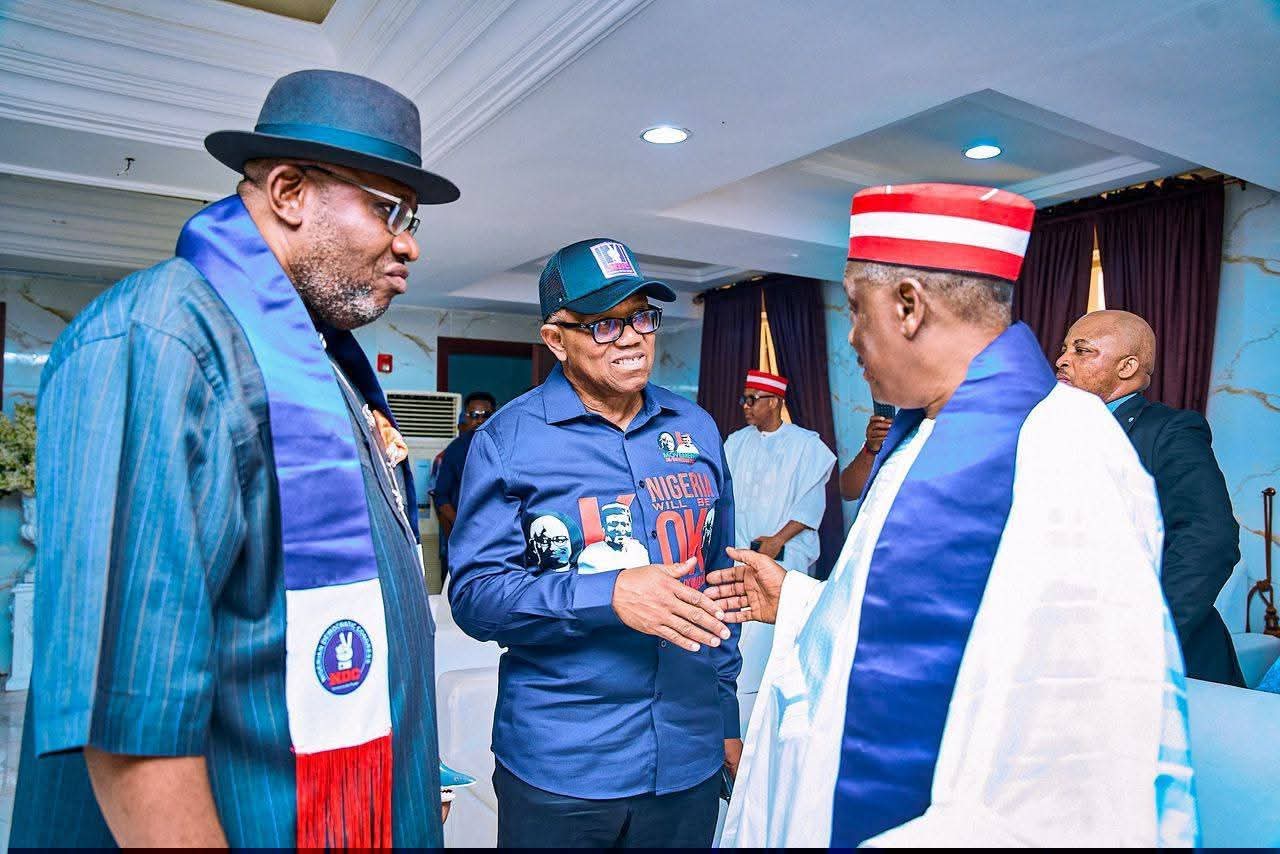
NDC Convention: Obi Urges Nigerians to Reject Transactional Leadership in 2027
By Ozor Gift Chinyere
Former presidential candidate of the Labour Party, Peter Obi, has called on Nigerians to reject what he described as “transactional leadership” and embrace competent, compassionate, and transformative governance ahead of the 2027 general elections.
Obi made the call on Friday while addressing delegates and party faithful at the first national convention of the Nigeria Democratic Congress held in the Los Angeles Event Center, Abuja.
Quoting former British Prime Minister, Winston Churchill, Obi said: “Some men change their party for the sake of their principles; others change their principles for the sake of their party.”
The former Anambra State governor said the successful convention demonstrated the resilience of Nigerians and their collective desire for political change despite the country’s current challenges.
He expressed appreciation to the leadership of the NDC, led by former Bayelsa State Governor and Senator, Henry Seriake Dickson, for what he described as their generosity and commitment to national progress at a critical period in Nigeria’s democratic journey.
Obi also commended the African Democratic Congress and its Interim National Chairman, David Mark, for providing what he termed a democratic platform and showing understanding following the legal disputes that affected both the Labour Party and the New Nigeria People’s Party (NNPP).
According to him, the spirit of solidarity among opposition political actors must remain the foundation for building a better Nigeria.
Speaking on the state of the nation, Obi lamented what he described as the gradual erosion of democratic values in the country, accusing some political actors of supporting actions capable of undermining democracy and the rule of law.
He said many individuals who once fought for justice and democratic ideals were now defending intimidation, coercion, electoral manipulation, and political oppression, particularly against opposition voices.
“What we are witnessing is not politics; it is a systematic assault on democracy and the will of the people,” Obi stated.
The former presidential candidate warned that Nigeria was drifting dangerously without a clear direction, noting that the country was increasingly being perceived globally as a failing state due to worsening insecurity, economic hardship, corruption, and weak institutions.
He said Nigeria was recording poor performances across key governance indicators, including accountability, political stability, rule of law, control of corruption, government effectiveness, and regulatory quality.
Obi further decried the rising poverty level in the country, stating that over 140 million Nigerians currently live in multidimensional poverty, while millions of young people remain unemployed or underemployed.
He noted that inflation, insecurity, and economic instability had continued to force businesses to shut down while farmers were unable to safely access their farmlands due to persistent attacks and kidnappings.
The former governor described the situation as heartbreaking, especially for families affected by insecurity, hunger, unemployment, and social dislocation.
According to him, Nigeria’s present challenges were not accidental but the result of years of leadership failure, corruption, and policies that prioritised personal interests above national development.
“Nigeria is not a poor country; rather, we are being looted into poverty,” Obi declared.
He urged Nigerians to choose between surrendering to national decline or collectively rebuilding the country on the foundations of unity, equity, justice, competence, and productivity.
Obi stressed that national unity had become a necessity, calling on citizens to rise above ethnic, religious, regional, and political divisions to rescue the country from further decline.
He advocated increased investment in agriculture and manufacturing, insisting that both sectors should become the major drivers of Nigeria’s Gross Domestic Product.
The former presidential candidate particularly called for strategic efforts to unlock the agricultural potential of Northern Nigeria and integrate it with industrial production across the federation.
He said Nigeria must urgently transition from a consumption-driven economy to a productive economy capable of creating jobs and restoring hope to citizens.
Obi also called for policies that would empower youths and women, insisting that young Nigerians should be treated as assets for national development rather than liabilities.
He maintained that with competent and people-oriented leadership, Nigeria could overcome insecurity, reduce corruption, create employment opportunities, stabilise the economy, improve education, and restore public confidence in governance.
Obi expressed optimism that a new Nigeria remained possible, describing his vision as a nation that is united, secure, productive, inclusive, and governed by justice and fairness.
He urged Nigerians to move forward with courage, unity, and collective determination towards rebuilding the country.