
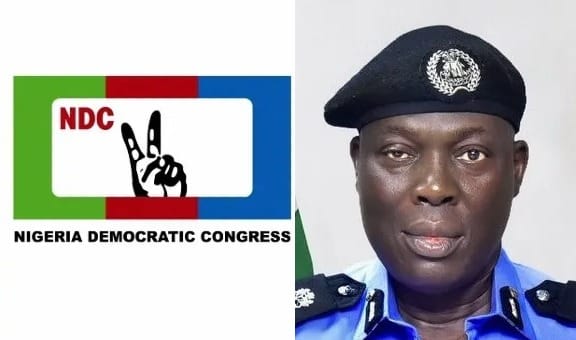
NDC Demands Removal of Lagos Police Commissioner Over Attendance at APC Support Group Inauguration
E-ISSN: 2354-4481
By Okah Ozioma Madison
The National Democratic Congress (NDC) has called for the immediate resignation or removal of the Lagos State Commissioner of Police, Olanrewaju Tijani, following his attendance at the executive inauguration of the City Boy Movement, a political support group associated with the ruling All Progressives Congress (APC).
The opposition party described the Commissioner's presence at the event as a serious breach of the neutrality expected of senior police officers, arguing that law enforcement agencies must remain politically impartial to preserve public confidence in Nigeria's democratic institutions.
In a statement issued on Thursday, the NDC condemned the Commissioner's participation, saying it sends the wrong signal at a time when the country is preparing for another electoral cycle. According to the party, the Inspector-General of Police and the Police Service Commission should immediately investigate the circumstances surrounding Tijani's attendance and take appropriate disciplinary measures.
"The office of a Commissioner of Police is one that demands absolute neutrality. Public confidence in the Nigeria Police Force depends largely on its ability to remain independent of partisan politics. Attending the inauguration of a political support group linked to a ruling party undermines that confidence," the statement said.
The party maintained that security agencies have a constitutional obligation to provide equal protection to all political parties and citizens, irrespective of political affiliation. It warned that any perception of political bias by security personnel could heighten public distrust ahead of future elections.
The NDC further argued that Nigeria's democratic system can only thrive when institutions responsible for maintaining law and order operate without political interference or perceived allegiance to any political interest.
The controversy has generated mixed reactions from political observers, civil society organisations, and members of the public.
Several democracy advocates expressed concern that the attendance of a serving Commissioner of Police at a political event could erode confidence in the impartiality of law enforcement during election periods. They argued that senior police officers must not only remain neutral but must also avoid actions capable of creating a perception of bias.
Some analysts noted that even where attendance at public functions is officially sanctioned, appearances at events organised by political groups require caution because they can easily be interpreted as institutional endorsement.
Others called on the Nigeria Police Force to issue clear operational guidelines regulating the participation of serving officers in political or partisan events in order to prevent similar controversies in the future.
However, some commentators urged caution against drawing premature conclusions, arguing that the full circumstances surrounding the Commissioner's attendance should first be established before disciplinary action is considered.
They stressed that if the appearance was in an official capacity or based on a statutory security responsibility, the facts should be made public to avoid speculation and misinformation.
As of the time of filing this report, neither the Lagos State Police Command nor the Nigeria Police Force Headquarters had issued an official statement explaining the Commissioner's presence at the inauguration.
Similarly, the City Boy Movement had not publicly responded to the criticism or clarified whether the Police Commissioner attended as a guest or in an official security capacity.
The controversy comes amid growing calls by political stakeholders for security agencies to demonstrate strict neutrality ahead of future elections. Electoral observers have consistently emphasized that the credibility of elections depends not only on the conduct of the Independent National Electoral Commission (INEC) but also on the professionalism and impartiality of security agencies responsible for maintaining law and order during the electoral process.
Over the years, concerns about alleged political interference involving security agencies have featured prominently in election observation reports, with civil society organisations repeatedly urging the police to strengthen public confidence through transparent and non-partisan conduct.
The NDC insisted that restoring confidence requires decisive action, maintaining that public officers occupying sensitive security positions must avoid activities capable of creating doubts about their independence.
The party reiterated that democratic governance is strengthened when institutions operate within the limits of the law and remain accountable to the Nigerian people rather than to partisan political interests.
The development is expected to generate further debate as political activities gradually intensify across the country ahead of the next round of elections.