
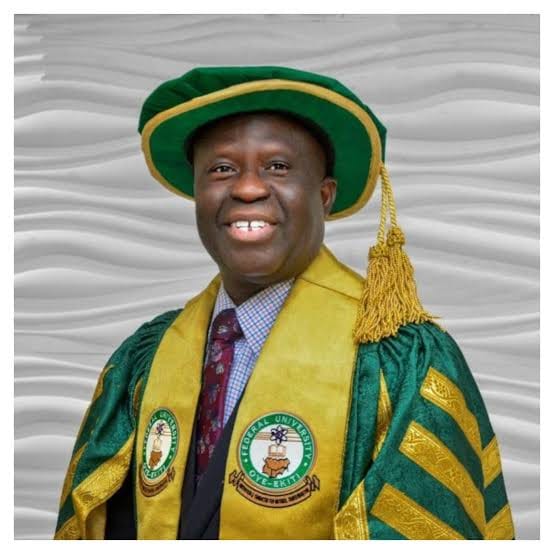
Senate Confirms Ex-FUOYE VC Abayomi Fasina as Non-Career Ambassador Despite Opposition
E-ISSN: 2354-4481
By Mboh Ebieh Shedrack
The Nigerian Senate on Thursday confirmed Professor Abayomi Fasina, the immediate past Vice-Chancellor of the Federal University Oye-Ekiti (FUOYE), as a non-career ambassador following a spirited debate that exposed differing views among lawmakers over his suitability for the diplomatic role.
The confirmation came after members of the upper chamber considered and adopted the report of the Senate Committee on Foreign Affairs, which recommended Fasina's confirmation despite concerns raised over pending court cases linked to allegations of sexual harassment.
The committee's report was presented by its Chairman, Senator Simon Lalong, who informed the Senate that available records from relevant institutions indicated that the nominee had been cleared of wrongdoing by the Federal University Oye-Ekiti Governing Council, the Nigeria Police Force, and the Department of State Services (DSS).
According to Lalong, the committee found no legal impediment that would prevent the Senate from confirming the former university administrator as a non-career ambassador.
However, the recommendation was challenged by Senator Adams Oshiomhole, who urged the Senate to exercise caution in approving the nomination while legal proceedings relating to the allegations were still before the courts.
Oshiomhole argued that confirming a nominee facing ongoing litigation on allegations bordering on sexual harassment could send the wrong signal to the public, particularly to women advocating for accountability and justice.
The former Edo State governor maintained that public office holders should be held to high ethical standards and stressed that appointments into sensitive diplomatic positions should inspire confidence both within Nigeria and internationally.
Responding to the concerns, Senate President Godswill Akpabio reminded lawmakers that the Senate must rely on verified facts rather than speculation or unproven claims.
Akpabio noted that the reports available before the chamber showed that the nominee had been investigated by the university authorities and relevant security agencies without any adverse findings against him.
He further observed that while civil matters may still be pending before the courts, the Senate should avoid making decisions based on allegations that have not resulted in any criminal conviction or legal disqualification.
Following extensive deliberations, the Senate adopted the committee's recommendation through a voice vote, thereby confirming Professor Fasina as a non-career ambassador of the Federal Republic of Nigeria.
The confirmation forms part of the Federal Government's ongoing efforts to fill vacant diplomatic positions in Nigerian missions abroad after the President forwarded a list of ambassadorial nominees to the National Assembly for legislative screening and approval.
Professor Fasina served as Vice-Chancellor of the Federal University Oye-Ekiti before completing his tenure and has built a career in academia and university administration.
His confirmation nevertheless underscores the growing debates surrounding the balance between the constitutional presumption of innocence and the need for public officials to meet the highest ethical expectations.
The Senate's decision has generated mixed reactions across political and civil society circles.
Supporters of the confirmation argue that public appointments should be guided by established legal principles, insisting that allegations alone should not be sufficient grounds to deny qualified nominees public office, particularly where investigative agencies have reported no criminal wrongdoing.
On the other hand, critics contend that the Senate missed an opportunity to reinforce public confidence in accountability by postponing the confirmation until all legal proceedings involving the nominee are concluded. They argue that diplomatic representatives should be free from controversies capable of attracting negative public perception.
Political analysts say the debate reflects the increasing scrutiny surrounding public appointments in Nigeria and the evolving expectations of transparency in governance.
According to governance experts, the Senate was confronted with two competing constitutional principles: the presumption of innocence, which protects individuals from punishment without due process, and the need to uphold public trust in government appointments.
Analysts further note that the discussion may influence future confirmation hearings, especially where nominees are subjects of ongoing civil litigation or public controversies.
They observe that while the Senate ultimately relied on reports from investigative agencies and its committee, the controversy highlights the importance of establishing clearer standards for assessing nominees whose cases remain before the courts.
With the confirmation concluded, attention now shifts to the executive arm of government for the formal deployment of Professor Fasina to his diplomatic assignment, alongside other newly confirmed non-career ambassadors.