
Osun People Have Spoken: Adeleke’s Re-Election Is a Mandate for Governance, Not Party Politics
ISSN: 2354-4481
By John Mbonu Uchenwoke-Ekperechi
Publisher/Editor-in-Chief, Inside Agwa News (IAN) | Columnist, “Shadow of the Flag” | Media Consultant | Political Analyst & Social Commentator | Convener, Renaissance Oguta Constituency (ROC)
Osun has spoken. The ballots have been counted, the mandate has been declared, and the political contest has ended. What remains is governance.
The August 15, 2026 Osun State governorship election produced Senator Ademola Jackson Nurudeen Adeleke of the Accord Party as winner. The Independent National Electoral Commission (INEC) declared Adeleke the winner after he polled 511,067 votes, defeating Munirudeen Bola Oyebamiji (“AMBO”) of the All Progressives Congress (APC), who scored 444,815 votes. African Democratic Congress (ADC) candidate Dr. Najeem Folasayo Salaam finished third with 17,180 votes. Adeleke won 19 of the state's 30 local government areas, while Oyebamiji won 11; Salaam did not win any LGA.
The figures tell one story; democracy tells another. The people of Osun exercised their constitutional franchise and made a choice. That choice deserves respect.
And perhaps the most important lesson is this: Osun People—not Accord, APC, ADC or any other political party—are the ultimate owners of the mandate.
Walter Cronkite once observed: “In seeking truth you have to get both sides of a story.” Walter Lippmann similarly wrote: “There can be no higher law in journalism than to tell the truth and shame the devil.” And Joseph Pulitzer's enduring warning remains relevant to democratic journalism: “Our Republic and its press will rise or fall together.”
These principles provide the appropriate compass for assessing Osun's political journey.
A State Built on Continuity
One important correction is necessary. Osun State was not created by General Sani Abacha. It was created from the old Oyo State on August 27, 1991, by the military administration of General Ibrahim Badamasi Babangida, with Osogbo as its capital.
The state's political history subsequently passed through military administration, the aborted Third Republic, and the Fourth Republic.
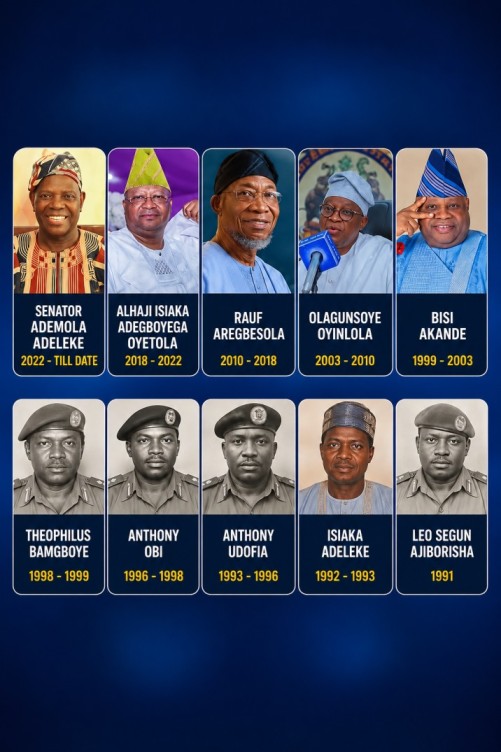
The administrators and governors were:
Col. Leo Segun Ajiborisha — Military Administrator, 1991–1992.
Alhaji Isiaka Adetunji Adeleke — First elected Executive Governor, 1992–1993.
Navy Capt. Anthony Udofia — Military Administrator, 1993–1996.
Col. Anthony Obi — Military Administrator, 1996–1998.
Col. Theophilus Bamigboye — Military Administrator, 1998–1999.
Chief Adebisi Bisi Akande — Executive Governor, 1999–2003.
Prince Olagunsoye Oyinlola — Executive Governor, 2003–2010.
Ogbeni Rauf Aregbesola — Executive Governor, 2010–2018.
Alhaji Gboyega Oyetola — Executive Governor, 2018–2022.
Senator Ademola Jackson Nurudeen Adeleke — Executive Governor, 2022–present.
The military administrations should not be casually erased from history. Ajiborisha, as the pioneer administrator, helped establish foundational institutions including the Osun State Civil Service Commission and the Osun State Broadcasting Corporation.
Isiaka Adeleke, despite serving barely two years, established institutions that became part of Osun's educational foundation, including the Polytechnic, Iree, and the College of Technology, Esa-Oke, while completing the Osun State Broadcasting Corporation.
Anthony Udofia, Anthony Obi and Theophilus Bamigboye administered the state during the military interregnum and oversaw the transition towards the restoration of democratic rule in 1999.
The Democratic Era: Different Governments, Different Legacies
Bisi Akande's administration (1999–2003) became associated with fiscal discipline, education reform and social-sector interventions. Records attributed to his administration include free primary and secondary education, expansion of health institutions, free medical services and construction of schools and science facilities.
Olagunsoye Oyinlola (2003–2010) placed emphasis on education, agriculture, water, health, transportation and social development. One of his most enduring institutional legacies was the establishment of Osun State University (UNIOSUN). The university's establishment law was passed in December 2006 and signed by Oyinlola, with NUC approval following in the same year. His administration also pursued welfare programmes and infrastructure and supported the development of Osun's cultural profile.
Rauf Aregbesola (2010–2018) left perhaps the most recognisable physical and social-policy imprint of the period. His administration's education reforms included the reclassification of schools, construction of new schools, Opon-Imo, O-Meals school feeding, uniforms and expanded education infrastructure. The state government also documented major interventions in roads and healthcare.
Gboyega Oyetola (2018–2022) continued several programmes in education, healthcare, infrastructure, social intervention and workers' welfare. His administration's documented projects included the Olaiya Flyover, road rehabilitation, a 120-bed ward at Asubiaro Specialist Hospital and health-insurance initiatives.
Then came Ademola Adeleke, who assumed office on November 27, 2022, after defeating Oyetola in the 2022 governorship election.
His administration's stated priorities have included workers' welfare, infrastructure, healthcare, education, agriculture, youth empowerment and economic development. Its reported interventions include road construction, rehabilitation of primary healthcare centres, school rehabilitation, agricultural support, cooperatives, water projects and digital-economy initiatives.
The administration has also reported significant investments in UNIOSUN, including lecture theatres, laboratories, sports facilities and campus infrastructure.
These achievements should be acknowledged as government claims and documented projects, while independent citizens, journalists and civil-society organisations should continue to scrutinise their quality, cost, sustainability and impact.
But Who Is Osun's Best Governor?
That question has no easy answer.
Aregbesola supporters may point to education reforms, O-Meals, Opon-Imo and roads. Oyinlola supporters may highlight UNIOSUN, infrastructure, agriculture and social programmes. Akande's admirers may emphasise fiscal discipline and education. Oyetola's supporters may cite infrastructure, healthcare and welfare interventions. Isiaka Adeleke's historical importance rests partly on being the state's first elected governor and establishing institutions during Osun's formative years.
Adeleke's supporters will point to his infrastructure drive, workers' welfare, healthcare, education and social programmes—and now, his 2026 re-election.
But history is not a popularity contest.
The best governor is ultimately the one whose governance produces the most durable improvement in the lives of citizens, strengthens institutions, protects public resources and leaves the state better prepared for the next generation.
The Mandate Is Bigger Than Accord
Governor Adeleke's re-election should therefore not be interpreted as a blank cheque for the Accord Party.
It is a mandate for government.
The people did not vote merely for a party logo. They voted for leadership, continuity, expectations and the promise of better living conditions.
The next four years must therefore transcend partisan triumphalism. The opposition should not be treated as an enemy; it remains an indispensable component of democratic accountability. Government must tolerate dissent, encourage constructive criticism and embrace political pluralism.
Opposition is not enmity. Dissent is a democratic right, not a political crime. Policies, not personalities, should define political competition.
For Adeleke, the task is now considerably greater than winning an election. He must build institutions that can outlive him.
He must strengthen education, healthcare, roads, agriculture, security, employment, environmental governance, social protection and the dignity of labour. He must deepen transparency, accountability and fiscal responsibility. He must ensure that rural communities are not forgotten while urban centres receive attention.
The people have handed him another four-year opportunity. Posterity will ask not how loudly the victory was celebrated, but what the victory produced.
Recap: What the Osun Vote Means
The 2026 election produced a decisive numerical victory for Adeleke: 511,067 votes against Oyebamiji's 444,815, while ADC's Najeem Salaam secured 17,180 votes.
But beyond the figures lies a profound democratic message: Osun's electorate has again demonstrated that political power ultimately derives from the ballot.
The election is over. The campaign rhetoric must now give way to governance.
The drums of partisan competition should become the rhythm of development.
Conclusion: History Will Be the Final Returning Officer
Governor Ademola Jackson Nurudeen Adeleke, your second mandate is not merely another political trophy. It is an opportunity to write your name permanently in the political history of Osun State.
Do not govern merely to be remembered as the man who won two elections.
Govern so that Osun remembers you as the leader who built institutions, transformed communities, protected the vulnerable, respected dissent, strengthened democracy and left the State of the Living Spring stronger than he met it.
Party victories fade. Political slogans disappear. Campaign posters become archives.
But roads remain. Schools remain. Hospitals remain. Institutions remain. Jobs remain. Human dignity remains.
That is the real test of leadership.
For the next four years, let the governing philosophy be simple:
Country before party. People before politics. Public interest before personal interest. Service before self.
And when history finally opens the book of Osun's governors, may the record show that Ademola Nurudeen Adeleke did not merely win an election—he used the mandate of the Osun people to build a legacy worthy of posterity.
Ideas, Issues, Integrity and Democracy.
Opposition Is Not Enmity. Ballots, Not Bullets. Transparency, Accountability and Service.
— John Mbonu Uchenwoke-Ekperechi
Publisher/Editor-in-Chief, Inside Agwa News (IAN)
Columnist, Shadow of the Flag | Media Consultant | Political Analyst & Social Commentator | Convener, Renaissance Oguta Constituency (ROC).